
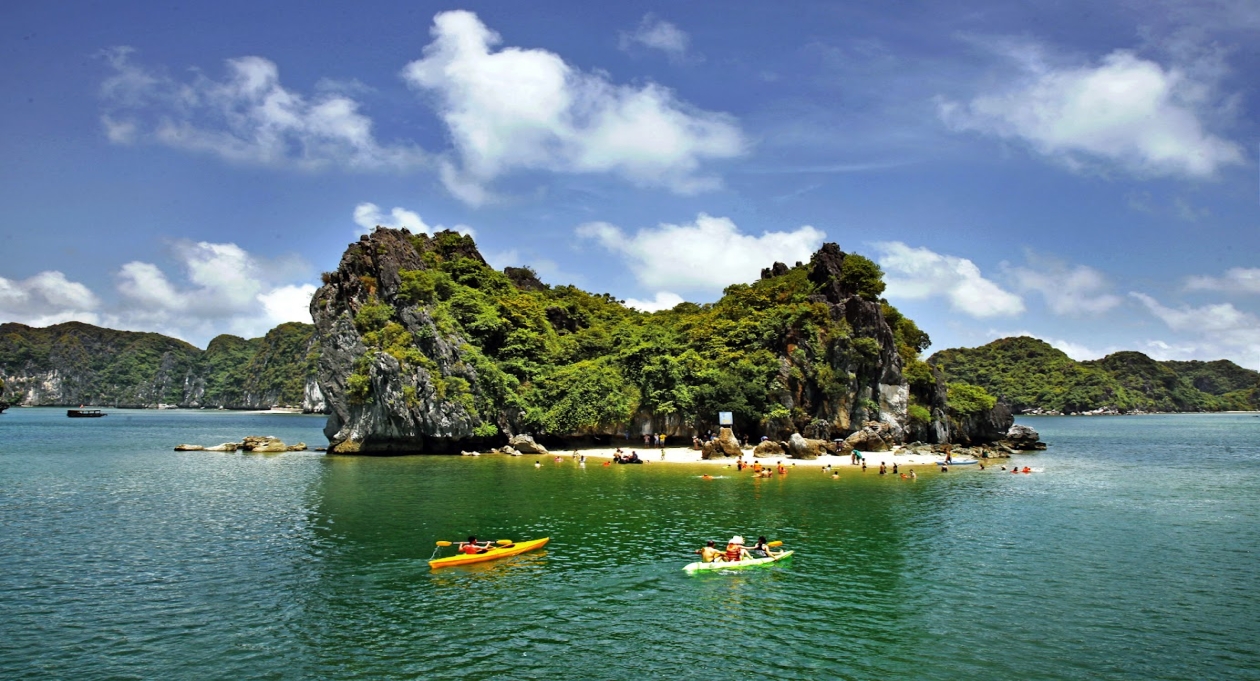
While neighbouring bays have long captured international attention, the quieter beauty of Lan Ha Bay lies in its sense of calm. Scattered with hundreds of limestone karsts and fringed by secluded coves, this coastal landscape invites travellers not merely to observe nature, but to enter it, gliding silently through sheltered lagoons or slipping into warm, translucent waters beneath towering stone formations.
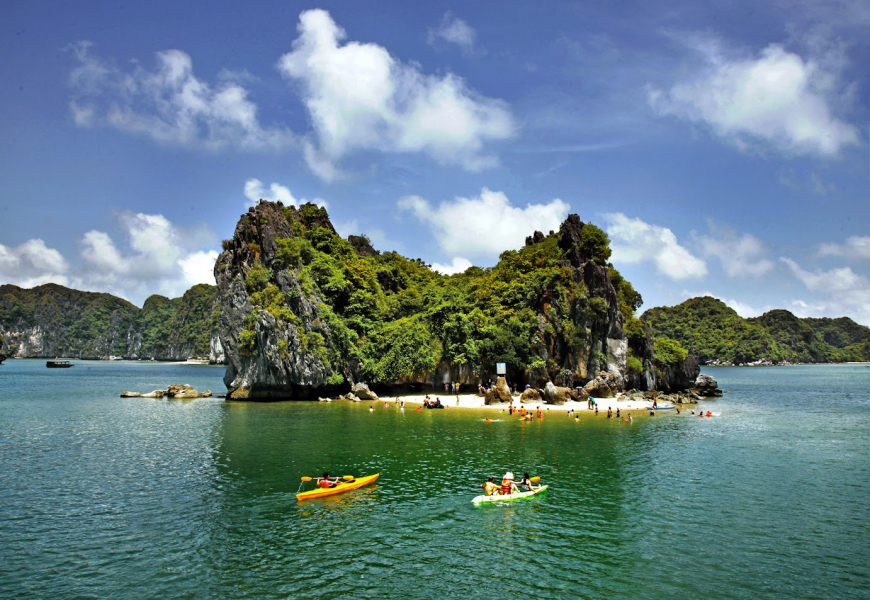
For many visitors, the experience begins in a kayak.
Unlike larger vessels that drift across the bay’s open stretches, a kayak moves at the pace of the landscape itself. The soft rhythm of paddles cutting through still water allows travellers to venture into narrow passages inaccessible to boats, weaving between limestone cliffs softened by time and tropical greenery. Hidden arches open unexpectedly onto enclosed lagoons where silence feels complete, interrupted only by seabirds overhead and the gentle movement of water against rock.
There is an intimacy to kayaking in Lan Ha Bay rarely found in more crowded marine destinations. Distances feel personal rather than vast; every turn reveals another pocket of stillness. Floating villages appear in quiet corners of the bay, fishing boats drift patiently on calm waters, and tiny beaches emerge between cliffs as though discovered by accident. Here, movement is unhurried, shaped less by itinerary than curiosity.
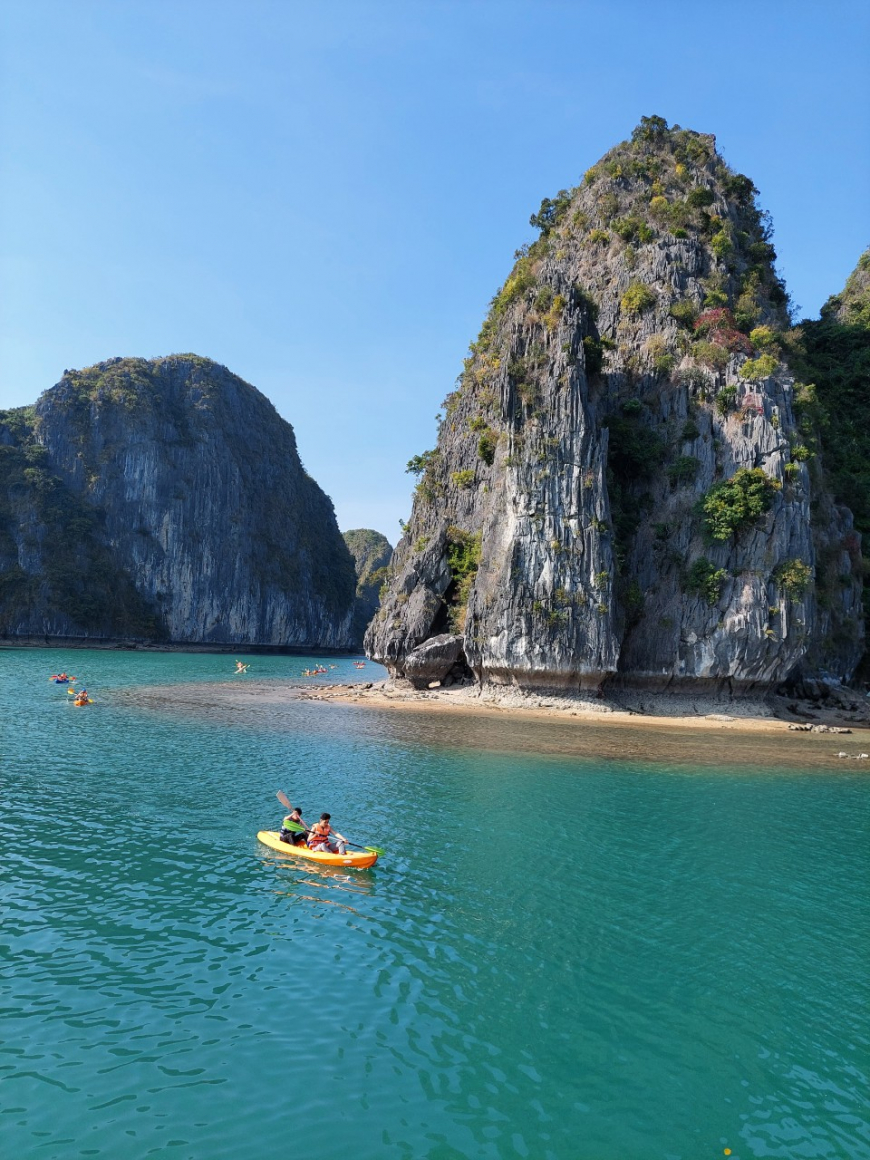
Yet Lan Ha Bay reveals another pleasure once the paddle is set aside: swimming.
The waters are often remarkably calm, protected by limestone islands that soften strong currents and create natural swimming spaces. In sheltered coves, the sea shifts between jade and turquoise, warm enough to encourage lingering rather than hurried immersion. Swimming here feels less like recreation and more like surrender, to silence, sunlight and the reassuring vastness of open water.
To drift in Lan Ha Bay is to experience a rare sense of scale. Limestone formations rise dramatically overhead, yet the water beneath remains unexpectedly gentle. Looking back towards distant boats, travellers may find themselves momentarily alone, suspended between cliffs and sky, the world reduced to sunlight dancing across the surface of the sea.
Swimming excursions often lead to quiet beaches hidden behind rocky outcrops, places reachable only by small boats or kayaks. These fragments of sand, untouched by crowds, invite simple pleasures: drying beneath the sun, listening to waves soften against limestone and watching the changing colours of the bay as clouds pass overhead.
What makes kayaking and swimming in Lan Ha Bay so memorable is not adrenaline or spectacle, but immersion. The bay rewards slowness. It asks travellers to exchange urgency for attentiveness to notice reflections trembling across emerald water, the texture of weathered cliffs, the hush that settles in remote corners of the sea.
In an age of hurried itineraries and crowded viewpoints, Lan Ha Bay offers something increasingly rare: space to move gently through a landscape and feel, however briefly, entirely part of it. Whether paddling through hidden waterways or floating beneath vast limestone skies, visitors discover not simply an activity, but a different rhythm of travel quieter, deeper and infinitely more restorative.